| others
of the same type, and up to October 30, 1835, ten of them had been placed
on the road. Contemporary with these were five locomotives built by Robert
Stephenson and Co., of New Castle-on-Tyne, England, and two others of American
construction, built respectively by Coleman Sellers and Sons, and Long
and Norris. The English locomotives, with their rigid wheel-bases and comparatively
light parts, were generally unsatisfactory and often in need of repairs.
The Baldwin engines were in high favor, regularly hauling gross loads of
75 tons over the road; while one of them made a record by hauling 100 tons.
They represented a type which was Mr. Baldwin's standard up to 1842, and
the total number of these Baldwin single-driver locomotives placed on the
Philadelphia and Columbia R. R., according to the records of the builders,
was 27.
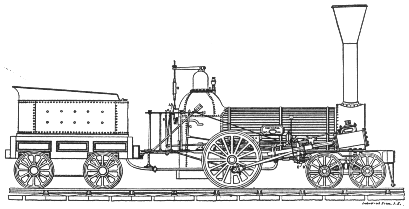
Contemporary with these early Baldwin locomotives was a group having the same wheel arrangement, and built by William Norris, also of Philadelphia. The most important difference in the two designs was the position of the driving wheels which, in the Baldwin engines, were back of the firebox, while in the Norris engines they were in front of the firebox. The Baldwin engines, with their longer wheel base, were the more steady riders,, while the Norris engines carried a larger portion of their weight on driving wheels, and had more adhesion and consequently greater hauling capacity. For this reason the Baldwin engines were generally preferred for passenger service and the Norris engines for freight. The Norris locomotives came into prominence shortly after they were placed on the road by reason of the fact that one of them, the "George Washington," on July 10, 1836, hauled a load of 19,200 pounds up the inclined plane at Philadelphia. This plane had a length of 2800 feet and a grade of 1 in 14 (377 feet per mile). The locomotive attained a speed of 15 miles per hour, while carrying a steam pressure of 60 pounds. This was regarded as a remarkable performance, and it was directly responsible for the receipt, by Mr. Norris, of an order from England for similar locomotives to work on the Lickey Incline, a grade of 1 in 37 on the Birmingham and Gloucester Ry. |
The "George Washington" was inside connected, and is stated as having cylinders
10¼ x 175/8
inches and driving wheels 48 inches in diameter.
It weighed 14,930 pounds with 8,700 pounds on drivers. It is reported as
having hauled over the road a train of 35 cars weighing 137 gross tons,
while a similar locomotive, the "Washington County Farmer," on one occasion
hauled a train of 28 cars weighing 141½ tons. This was the first outside
connected Norris locomotive. Its performance, however, was subsequently
exceeded by one of Mr. Baldwin's single driver engines, the "West Chester,"
which hauled a train of 51 four-wheeled cars, weighing 289 net tons, over
the road, some of the track being of wood covered with strap rail. During
the year 1837 a number of these Baldwin locomotives were operated at a
cost for repairs of only 1.2 to 1.6 cents per mile.
The need for locomotives of greater capacity soon began to be felt, and in 1845 the Philadelphia & Columbia received from The Baldwin Locomotive Works a six-coupled locomotive of approximately 15 tons weight, having 14 x 18-inch cylinders and driving wheels 42 inches in diameter. This locomotive was equipped with the well-known Baldwin Flexible Beam Truck, in which the first and second axles were allowed a limited amount of lateral motion, the one to the right and the other to the left, or vice versa. To facilitate this, the coupling rods had spherical brasses and the driving boxes were fitted into cylindrically bored pedestals, which were held in vibrating beams. This construction provided the flexibility so necessary in order to enable a locomotive to work on the sharp curves and uneven tracks which characterized the railroads of the period.
|