Chapter 9
Many of the most
thrilling sights and experiences were those of railroad employees and passengers.
Mr. Henry, the engineer of the second section of express train No. 8, which
runs between Pittsburg and Altoona, was at Conemaugh when the great flood
came sweeping down the valley. he was able to escape to a place of
safety. His was the only train that was not injured, even though
it was in the midst of the great wave. The story as related by Mr.
Henry is most graphic.
"It was
an awful sight," he said. "I have often seen pictures of flood scenes
and I thought they were exaggerations, but what I witnessed last Friday
changes my former belief. To see that immense volume of water, fully
fifty feet high, rushing madly down the valley, sweeping everything before
to, was a thrilling sight. It is engraved indelibly on my memory.
Even now I can see that mad torrent carrying death and destruction before
it.
"The second
section of No. 8, on which I was, was due at Johnstown about quarter part
ten in the morning. We arrived there safely and were told to follow
the first section. When we arrived at Conemaugh the first section
and the mail were there. Washouts further up the mountain prevented
our going on, so we could do nothing but sit around and discuss the situation.
The creek at Conemaugh was swollen high, almost overflowing. The
heavens were pouring rain, but this did not prevent nearly all the inhabitants
of the town from gathering along its banks. They watched the waters
go dashing by and wondered whether the creek would get much higher.
But a few inches more and it would overflow its banks. There seemed
to be a feeling of uneasiness among the people. They seemed to fear
that something awful was going to happen. Their suspicions were strengthened
by the fact that warning had come down the valley for the people to be
on the lookout. The rains had swollen everything to the bursting
point. They day passed slowly, however. Noon came and went,
and still nothing happened. We could not proceed, nor could we go
back, as the tracks about a mile below Conemaugh had been washed away,
so there was nothing for us to do but to wait and see what would come next.
"Some time
after three o’clock Friday afternoon I went into the train dispatcher’s
office to learn the latest news. I had not been there long when I
heard a fierce whistling from an engine away up the mountain. Rushing
out I found dozens of men standing around. Fear had blanched every
cheek. The loud and continued whistling had made every one feel that
something serious was going to happen. In a few moments I could hear
a train rattling down the mountain. About five hundred years above
Conemaugh the tracks make a slight curve and we could not see beyond this.
The suspense was something awful. We did not know what was coming, but
no one could get rid of the thought that something was wrong at the dam.
"Our suspense
was not very long, however. Nearer and nearer the train came, the
thundering sound still accompanying it. There seemed to be something
behind the train, as there was a dull, rumbling sound which I knew did
not come from the train. Nearer and nearer it camel a moment more
and it would reach the curve. The next instant there burst upon our
eyes a sight that made every heart stand still. Rushing around the
curve, snorting and tearing, came an engine and several gravel cars.
The train appeared to be putting forth every effort to go faster.
Nearer it came, belching forth smoke and whistling long and lout.
But the most terrible sight was to follow. Twenty feet behind cam
surging along a mad rush of water fully fifty feet high. Like the
train, it seemed to be putting forth every effort to push along faster
. Such an awful race we never before witnessed. For an instant
the people seemed paralyzed with horror. They knew not what to do,
but in a moment they realized that a second’s delay meant death to them.
With one accord they rushed to the high lands a few hundred feet away.
Most of them succeeded in reaching that place and were safe.
"I thought
of the passengers in my train. The second section of No. 8 had three
sleepers. In these three cars were about thirty people, who rushed
through the train crying to the others ‘Save yourselves!’ Then came
a scene of the wildest confusion. Ladies and children shrieked and
the men seemed terror-stricken. I succeeded in helping some ladies
and children off the train and up to the high lands. Running back, I caught
up two children and ran for my life to a higher place. Thank God,
I was quicker than the flood! I deposited my load in safety on the
high land just as it swept past us.
"For nearly an
hour we stood watching the mad flood go rushing by. The water was
full of debris. When the flood caught Conemaugh it dashed against
the little town with a might crash. The water did not lift the houses
up and carry them off, but crushed them up one against the other and broke
them up like so many egg-shells. Before the flood came there was
a pretty little town. When the waters passed on there was nothing
but a few broken boards to mark the central portion of the city.
It was swept as clean as a newly0brushed floor. When the flood passed
onward down the valley I went over to my train. It had been moved
back about twenty yards, but it was not damaged. About fifteen persons
had remained in the train and they were safe. Of the three trains
ours was the luckiest. The engines of both the others had been swept
off the track, and one or two cars in each trains had met the same fate.
What saved our train was the fact that just at the curve which I mentioned
the valley spread out. The valley is six or seven hundred yards broad
where our train was standing. This, of course, let the floods pass
out. It was only about twenty feet high when it struck our train,
which was bout in the middle of the valley. This fact, together with
the elevation of the track, was all that saved us. We stayed
that night in the houses in Conemaugh that had not been destroyed,
The next morning I started down the valley and by four o’clock in
the afternoon had reached Conemaugh furnace, eight miles west of Johnstown.
Then I got a team and came home.
"In my tramp
down the valley I saw some awful sights. On the tree branches hung
shreds of clothing torn from the unfortunates as they were whirled along
in the terrible rush of the torrent. Dead bodies were lying by scores
along the banks of the creeks. One woman I helped drag from the mud
had tightly clutched in her hand a paper. We tore it our of her hand
and found it to be a badly water-soaked photograph. It was probably
a picture of the drowned woman."
Pemberton Smith is a civil engineer employed
by the Pennsylvania Railroad. On Friday, when the disaster occurred,
he was at Johnstown, stopping at the Merchants’ Hotel. What happened
he described as follows:
"In the afternoon,
with four associates, I spent the time playing checkers in the hotel, the
streets being flooded during the day. At half-past four we were startled
by shrill whistles. Thinking a fire was the cause, we looked out
of the window. Great masses of people were rushing through the water
in the street, which had been there all day, and still we thought the alarm
was fire. All of a sudden the roar of the water burst upon our ears,
and in an instant more the streets were filled with debris. Great
houses and business blocks began to topple and crash into each other and
go down as if they were toy-block houses. People in the streets were
drowning on all sides. One of our company started down-straits and
was drowned. The other four, including myself, started up-stairs,
for the water was fast rising. When we got on the roof we could see
whole blocks swept away as if by magic. Hundreds of people were floating
by, clinging to roofs of houses, rafts, timbers, or anything they could
get a hold of. The hotel began to tremble, and we made our way to
an adjoining roof. Soon afterward part of the hotel went down.
The brick structures seemed to fare worse than frame buildings, as the
latter would float, while the brick would crash and tumble into one great
mass of ruins. We finally climbed into a room of the last building
in reach and stayed there all night, in company with one hundred
and sixteen other people, among the number being a crazy man.. His
wife and family had all been drowned only a few hours before, and he was
a raving maniac. And what a night! Sleep! Yes, I did
a little, but every now and then a building near by would crash against
us, and we would all jump, fearing that at last our time had come.
"Finally morning
dawned. In company with one of my associates we climbed across the
tops of houses and floating debris, built a raft, and poled ourselves ashore
to the hillside. I don’t know how the others escaped. This
was seven o’clock on Saturday morning. We started on foot for South
Fork, arriving there at three P. M. Here we found that all communication
by telegraph and railroad was cut off by the flood, and we had naught to
do but retrace our steps. Tired and footsore! Well, I should
say so. My gum-boots had chafed my feet so I could hardly walk at
all. The distance we covered on foot was over fifty miles.
On Sunday we got a train to Altoona. Here we found the railroad connections
all cut off, so we came back to Johnstown again on Monday. What a
desolate place! I had to obtain a pass to go over into the city.
Here it is:
"Pass Pemberton Smith through all the streets.
"Alec. Hart, Chief of Police.
"A.J. Maxham, Acting Mayor."
"The tragic pen-pictures
of the scenes in the press dispatches have not been exaggerated.
They cannot be. The worse sight of all was to see the great fire
at the railroad-bridge. It makes my blood fairly curdle to
think of it. I could see the lurid flames shoot heavenward all night
Friday, and at the same time hundreds of people were floating right toward
them on top of houses, etc., and to meet a worse death than drowning.
To look at a sight like this and not be able to render a particle of assistance
seemed awful to bear. I had a narrow escape, truly. In my mind
I can hear the shrieks of men, women, and children, the maniac’s ravings,
and the wild roar of a sea of water sweeping everything before it."
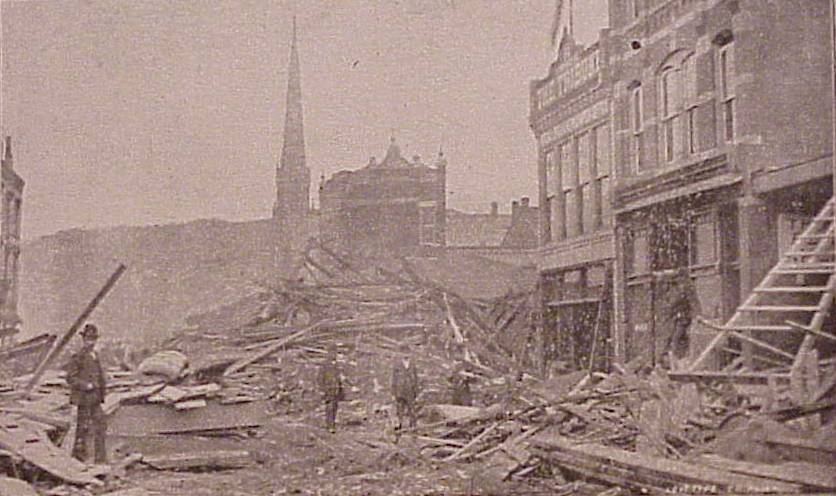 View On Clinton Street Johnstown
Among the lost
was Miss Jennie Paulson, a passenger on a railroad train, whose fate is
thus described by one of her comrades:
"We had been
making but slow progress all the day. Our train lay at Johnstown
nearly the whole day of Friday. We then proceeded as far as Conemaugh,
and had stopped from some cause or other, probably on account of the flood.
Miss Paulson and a Miss Bryan were seated in front of me. Miss Paulson
had on a plaid dress, with shirred waist of red cloth goods. Her
companion was dressed in black. Both had lovely corsage bouquets
of roses. I had heard that they had been attending a wedding before
they left Pittsburg. The Pittsburg lady was reading a novel entitled
Miss Lou. Miss Bryan was looking out of the window. When the
alarm came we all sprang toward the door, leaving everything behind us.
I had just reached the door when poor Miss Paulson and her friend, who
were behind me, decided to return for their rubbers, which they did.
I sprang from the car into a ditch next the hillside, in which the water
was already a foot and a-half deep, and, with the others, climbed up the
mountain side for our very lives. We had to do so, as the water glided
up after us like a huge serpent. Any one ten feet behind up would
have been lost beyond a doubt. I glanced back at the train when I
had reached a place of safety, but the water already covered it, and the
Pullman car in which the ladies were was already rolling down the valley
in the grasp of the angry waters."
Mr. William Scheerer, the teller of the
State Banking Company, of Newark, N.J., was among the passengers on the
ill-fated day express on the Pennsylvania Railroad that left Pittsburg
at eight o’clock A.M., on the now historic Friday, bound for New York.
There was some
delays incidental to the floods in the Conemaugh Valley before the train
reached Johnstown, and a further delay at that point, and the train was
considerably behind time when it left Johnstown. Said Mr. Scheerer:
"The parlor car was fully occupied when I went aboard the train, and a
seat was accordingly given me in the sleeper at the rear end of the train.
There were several passengers in this car, how many I cannot say exactly,
among them some ladies. It was raining hard all the time and we were
not a very excited nor a happy crowd, but were whiling away the time in
reading and in looking at the swollen torrent of the river. Very
few of the people were apprehensive of any danger in the situation, even
after we had been held up at Conemaugh for nearly five hours.
"The railroad
tracks where our train stopped were full fourteen feet above the level
of the river, and there was a large number of freight and passenger cars
and locomotives standing on the tracks near us and strung along up the
road for a considerable distance. Between the road and the hill that
lay at our left there was a ditch, through which the water that came down
from the hill was running like a mill-race. It was a monotonous wait
to all of us, and after a time many inquiries were made as to why we did
not go ahead. Some of the passengers who made the inquiry were answered
laconically --‘Wash-out,’ and with this they had to be satisfied.
I had been over the road several times before, and knew of the existence
of the dangerous and threatening dam up in the South Fork gorge, and could
not help connecting it in my mind with the cause of our delay. But
neither was I apprehensive of danger, for the possibility of the dam giving
away had been often discussed by passengers in my presence, and everybody
supposed that the utmost damage it would do when it broke, as everybody
believed it sometime would, would be to swell a little higher the current
that tore down through the Conemaugh Valley.
"Such a possibility
as the carrying away of a train of cars on the great Pennsylvania road
was never seriously entertained by anybody. We had stood stationary
until about four o’clock, when two colored porters went through the car
within a short time of each other, looking and acting rather excited.
I asked the first one what the matter was, and he replied that he did not
know. I inferred from his reply that if there was any thing serious
up, the passengers would be informed, and so I went on reading. When
the next man came along I asked him if the reservoir had given way, and
he said he thought it had.
"I put down my
book and stepped out quickly to the rear platform, and was horrified at
the sight that met my gaze up the valley. It seemed as if a forest
was coming down upon us. There as a great wall of water roaring and
grinding swiftly along, so thickly studded with the trees from along the
mountain sides that it looked like a gigantic avalanche of trees.
Of course I lingered but an instant, for the mortal danger we all were
in flashed upon me at the first sight of that terrible on-coming torrent.
But in that instant I saw an engine lifted bodily off the track and thrown
over backward into the whirlpool, where it disappeared, and houses crushed
and broken up in the flash of an eye.
"The noise was
like incessant thunder. I turned back into the car and shouted to
the ladies, three of whom alone were in the car at the moment, to fly for
their lives. I helped them out of the car on the side toward the
hill, and urged them to jump across the ditch and run for their lives.
Two of them did so, but the third, a rather heavy lady, a missionary, who
was on her way to a foreign station, hesitated for an instant, doubtful
if she could make the jump. That instant cost her her life.
While I was holding out my hand to her and urging her to jump, the rush
of the waters came down and swept her, like a doll, down into the torrent.
In the same instant an engine was thrown from the track into the ditch
at my feet. The water was about my knees as I turned and scrambled
up the hill, and when I looked back, ten seconds later, it was surging
and grinding ten feet deep over the track I had just left.
"The rush of
waters lasted three-quarters of an hour, while we stood rapt and spell-bound
in the rain, looking at the ruin no human agency could avert. The
scene was beyond the power of language to describe. You would see
a building standing in apparent security above the banks of the swollen
river, the people rushing about the doors, some seeming to think that safety
lay indoors, while others rushed toward higher ground, stumbling and falling
in the muddy streets, and then the flood rolled over them, crushing in
the house with a crash like thunder, and burying house and people out of
sight entirely. That, of course, was the scene in only an instant,
for our range of vision was only over a small portion of the city.
"We sought shelter
from the rain in the home of a farmer who lived high up on the side-hill,
and the next morning walked down to Johnstown and viewed the ruins.
It seemed as if the city was utterly destroyed. The water was deep
over all the city and few people were visible. We returned to Conemaugh
and were driven over the mountains to Ebensburg, where we took the train
for Altoona, but finding we could get no further in that direction we turned
back to Ebensburg, and from there went by wagon to Johnstown, where we
found a train that took us to Pittsburg. I got home by the New York
Central."
Go
on to chapter 10!
 This page has been accessed 10610 times since October 22, 1998
Last modified on:
©1998-2018 Robert Schoenberg - robs@railfan.net