Unit #14380 with pneumatic rubber tires, Jersey City, NJ, exact location and date unknown.
Photographer unknown, collection of Robert Schoenberg
I've always thought that they were some of the neatest oddball PRR equipment. They even had license plates! One of these days, I hope to model one...
If you can help me out determining the exact dates and locations in Jersey City or Baltimore of any of these photos, or if you have any more information about or photos or diagrams of these switchers that I can add to this page, please e-mail me at robs@railfan.net.
Here are links to some period journal articles about the tractors around the time of their development:
"The Development of an Electric Tractor for Handling Freight Cars Over Tracks Laid on City Streets" By T. V. Buckwalter. From the Society of Automobile Engineers Transactions from 1914 pages 231-254. Very detailed article! I OCR'd it and converted it to html for easier reading...
"Electric Tractor for Switching Service in City Streets" From Electric Railway Journal Volume XLI, No. 17, page 768. Short article about the tractors being placed in service.
"Personal Notes of the Automobile Trade" From The Horseless Age July 15, 1917, page 48. Short biography of T. V. Buckwalter.
"Industrial Trucks on the Pennsylvania Railroad" From Traffic World, 1915. Article on electric trucks used on the PRR including the street tractors.
Unit #14380 with pneumatic rubber tires, Jersey City, NJ, exact location and date unknown.
Photographer unknown, collection of Robert Schoenberg

Unit #14380, Jersey City, NJ, October 3, 1955.
"This is 14380 at jersey City on October 3, 1955. Here, they switched the big Colgate plant by the Hudson River. An Alco switcher just to the right of that catenary pole has handed off two boxcars to this little unit. Shortly, when the air brakes are hooked up, he will get underway."
photo and caption by Paul Carleton, from A Diesel Power Review, page 218, used with permission.
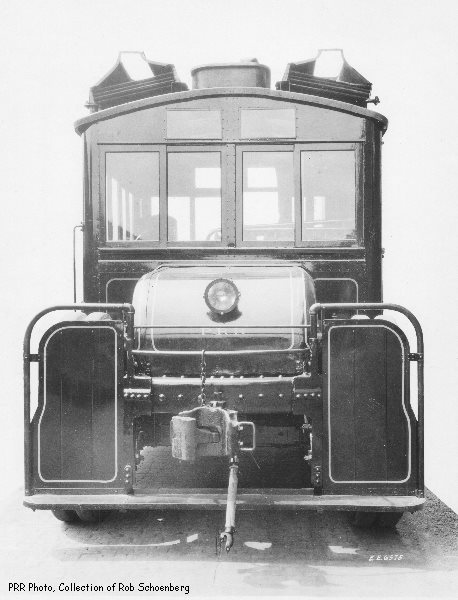
Builders photo of the end of #14380.
Pennsylvania Railroad Photo, EE6575, Collection of Rob Schoenberg

Builders photo of the side of #14380.
Pennsylvania Railroad Photo, EE6573, Collection of Rob Schoenberg
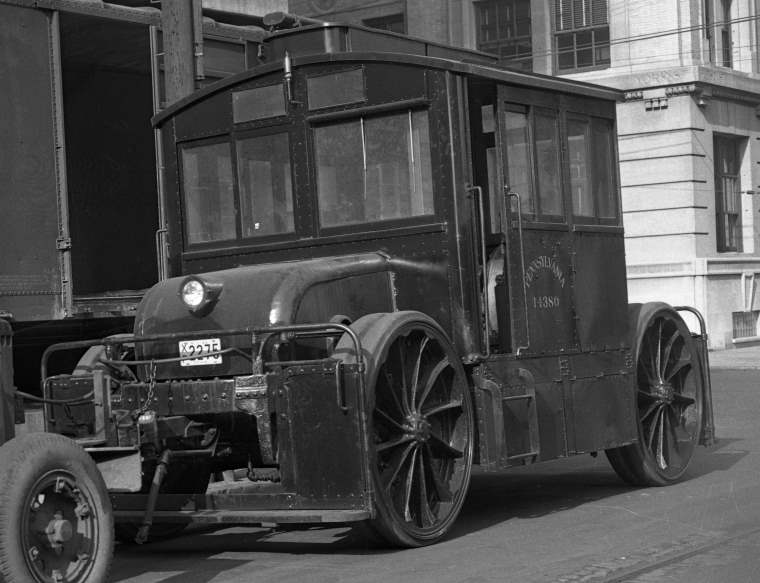
Photo of Unit 14380 at the corner of York and Hudson Streets in Jersey. Circa 1948.
Photographer Unknown, Collection of Rob Schoenberg.
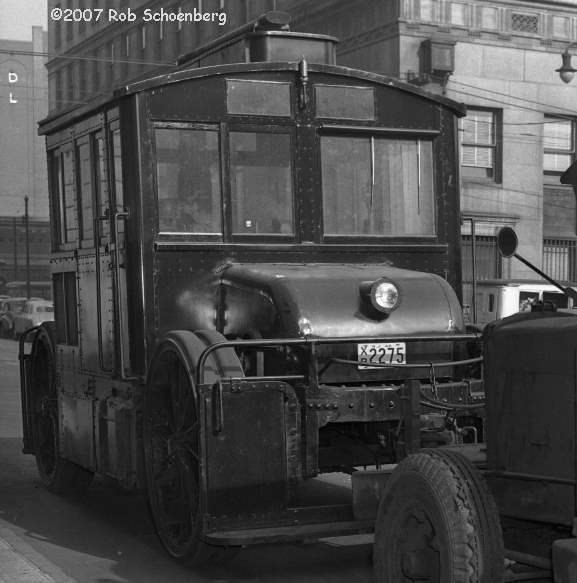
Photo of the other side of unit 14380 at the corner of York and Hudson Streets in Jersey. Circa 1948.
Photographer Unknown, Collection of Rob Schoenberg.
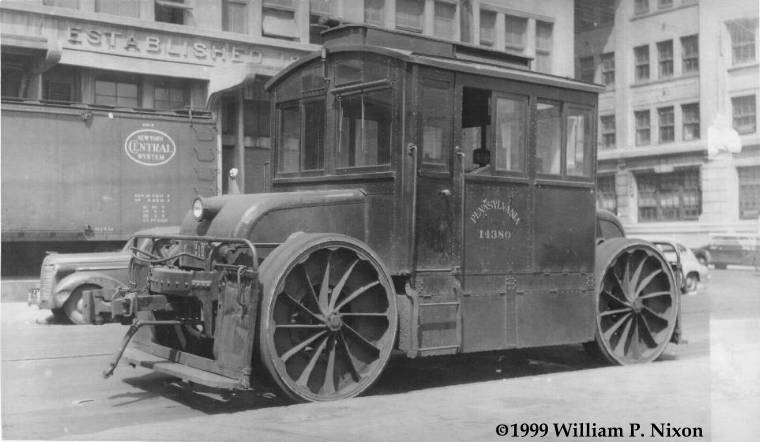
Here we are at the corner of York and Hudson Streets in Jersey City, NJ on April 22, 1949 with another view of unit 14380.
In this photo it still has it's original spoked wheels. (Compare
to the first photo above.)
Photographer unknown, collection of Bill Nixon (Neg #PR00723)
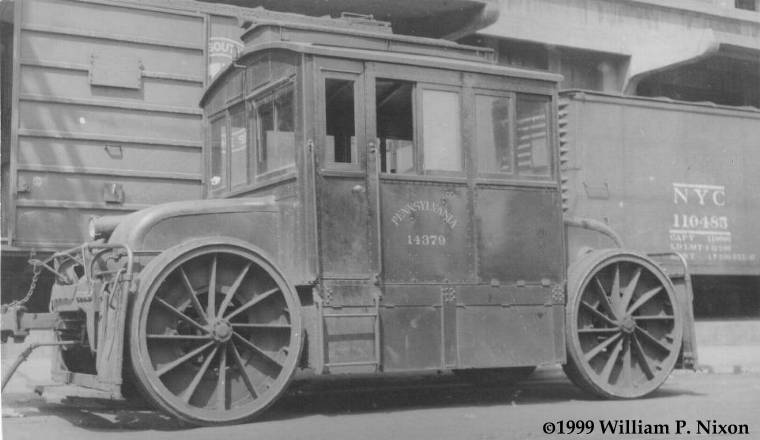
Just down the street from the above photo of 14380, here's a view of unit 14379. Seen on the same day as the photo of 14380 above (April 22, 1949)
That's the same NYC boxcar and building in the background.
Photographer unknown, collection of Bill Nixon (Neg #PR00722)
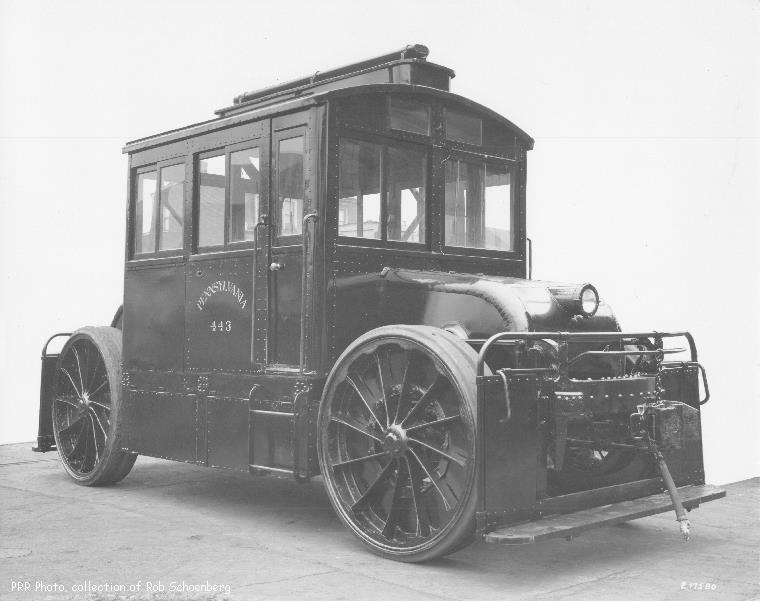
3/4 view builders photo of unit 443.
Pennsylvania Railroad Photo, E17580, Collection of Rob Schoenberg
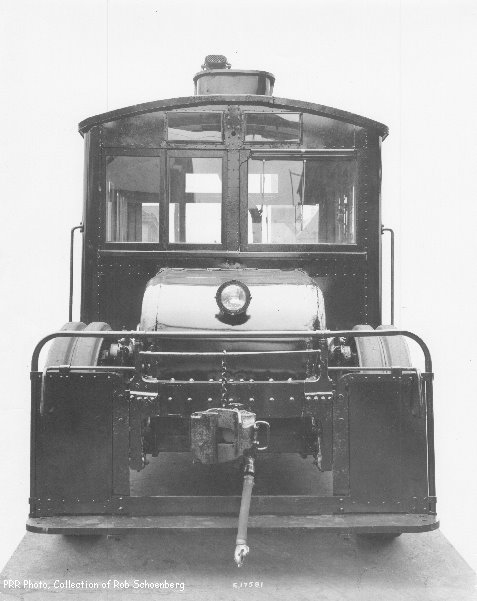
End view builders photo of unit 443.
Pennsylvania Railroad Photo, E17580, Collection of Rob Schoenberg

Here we see unit 443 on Thames Street in the Fells Point neighborhood in Baltimore, Md. on January 27, 1954.
Photographer unknown, Bill Nixon Collection (neg #PR01362)

Nice shot of the 444 pulling a string of H30 covered hoppers (with #254297 at the front) on Thames Street passing the Ruckert Terminals Corp. buiding in the Fells Point section of Baltimore.
Pennsylvania Railroad Photo, E20074, Collection of Rob Schoenberg,
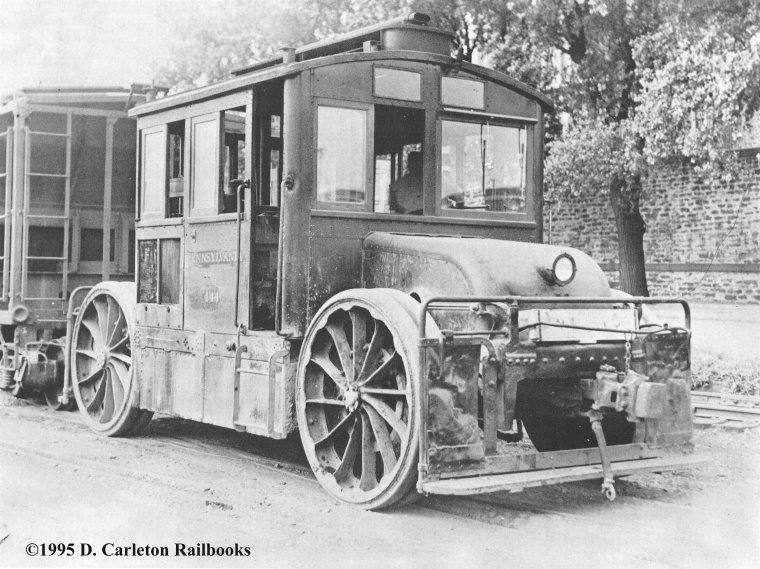
"Rubber tired switcher 444 at Baltimore, Maryland [on Monument Steet] on June 15, 1946 was one of the strangest pieces of motive power ever on the PRR roster. The hard rubber tires had a slot in them to guide this creature alng the rails. Tight curves kept steel wheeled switchers away from these tracks."
photographer unknown, collection of D. Carleton Railbooks. Caption by Paul Carleton, from A Diesel Power Review, page 218, used with permission.
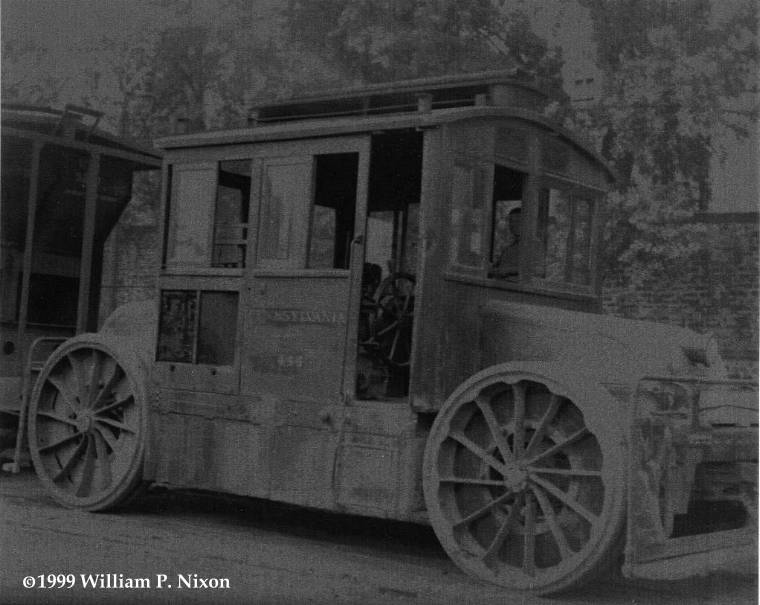
Here's a photo of unit 444 just down Monument Street from the previous photo in Baltimore taken sometime in 1946
by an unknown photographer.
Collection of Bill Nixon (neg # PR01376)
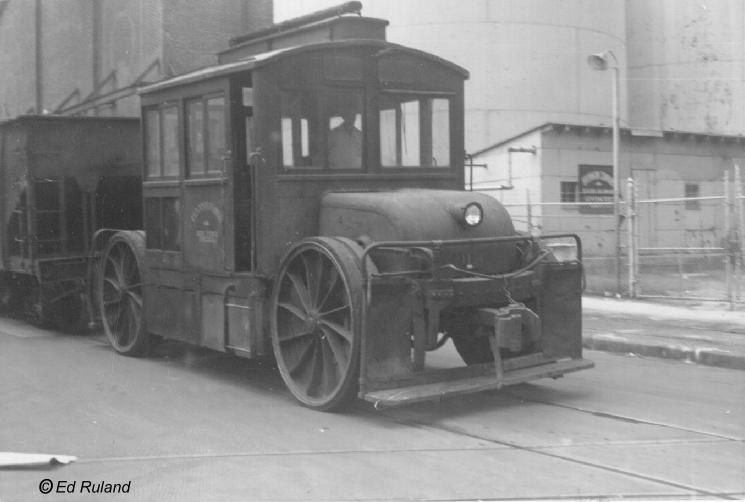
Unit #445 with H21A Hopper #723067, somewhere in Baltimore. Date unknown.
Photograph by and collection of Ed Ruland Note that I previously had the location of Ed's photos of 445 wrong.

Unit #445 with H21A Hopper #723067, on Eastern Avenue in Baltimore. Date unknown.
Note the ship type steering wheel in the cab!
Photograph by and collection of Ed Ruland
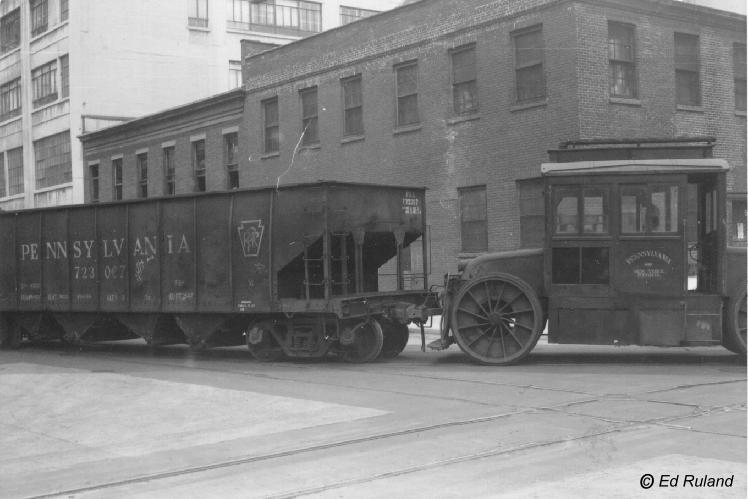
Unit # 445 with H21A Hopper #723067, turning from Central Avenue onto Eastern Avenue. Date unknown.
Photograph by and collection of Ed Ruland

Here's another photo of unit 445, this time on April 8th 1950 on Eastern Avenue in Baltimore,
Md.
Photographer unknown, collection of Bill Nixon (neg #PR00026)

Unit 446 is seen during November of 1962 at the President Street Yard, Baltimore, Maryland,
in color!
Is that an old PRR delivery van in the background?
Photographer unknown, collection of Bill Nixon (Neg # PR50049)
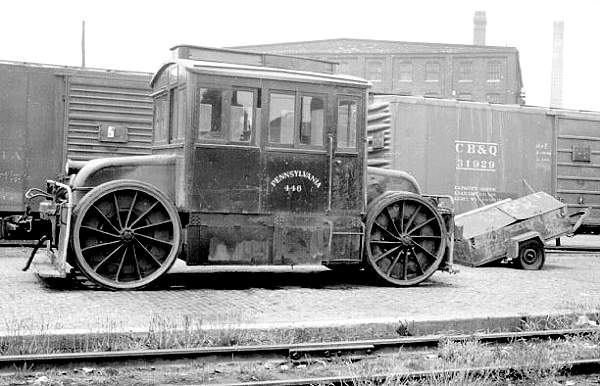
Unit 446 at the President Street Yard, Baltimore, Maryland, on an unknown date.
Bill Volkmer photo. Courtesy of Dave's Railpix.
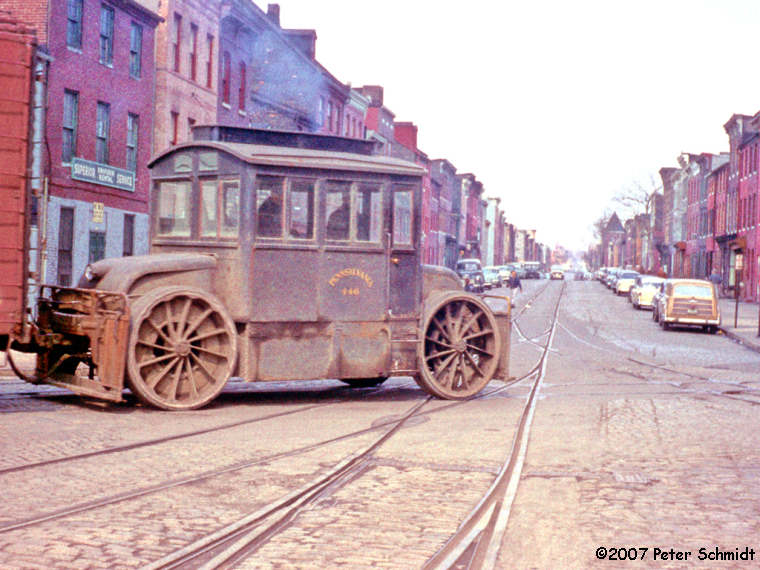
Here's a shot by Peter Schmidt taken in around 1958 of unit #446 in Baltimore at the corner of Bond and Thames streets.
The tractors operated in Fells Point, a very old part of the city, now quite trendy. Several blocks still have the tracks exposed, unused of course. The tractors could not operate on conventional (unpaved) track, so needed a paved interchange yard with locomotive-hauled trains. The major interchange was on Aliceanne Street just west of Central, very near President Street Station. The locomotive-hauled train would head west on Boston St. (the original PB&W mainline) then branch off on Aliceanne. (Trains to President Street would stay on Boston for one more block and head west on Fleet.) The train would be left in the middle of Aliceanne, where the tractor would classify the train into six or eight tracks in a paved yard to the south. Cars would be delivered several at a time to local industries and team tracks. The tractor would make up a train on Fleet Street to be picked up by a conventional switcher and pulled back east. Two of the shots show that operation.
The rear end-piece of Triumph VI has a good map of the tracks in the area. Looking at map on page 290 of Triumph VI, it appears the tractors operated primarily on track originally belonging to the Northern Central, which reached Fells Point from near Central Station on track in the middle of Monument Street east to Central, south on Central, east on Eastern Avenue, and south on Bond. This relatively long route across the city was still in operation using the tractors. There was a second paved interchange yard just north of Monument between Guilford and the Fallsway. By this time, Monument Street was oneway west and traffic was quite heavy. Rather than fight against the traffic when heading east, if the tractor was light, it would just head down the east bound street, which had no tracks. Actually I think the big advantage of the tractors was that they could take shortcuts like this when not towing cars, and could run around set-outs without a passing siding. It the day of full-crew agreements, I suspect they required a smaller crew, probably only three men?
The old tractors had license plates for hard-rubber-tired vehicles. They were single-digit numbers. I suspect there were few if any other hard-rubber tired vehicles still in operation at the time. I recollect that they had air whistles and a huge vertical steering wheel in the center of the cab with spokes just like on a ship. The new tractors had multiple conventional steering wheels so the operator could sit on either side facing either direction.
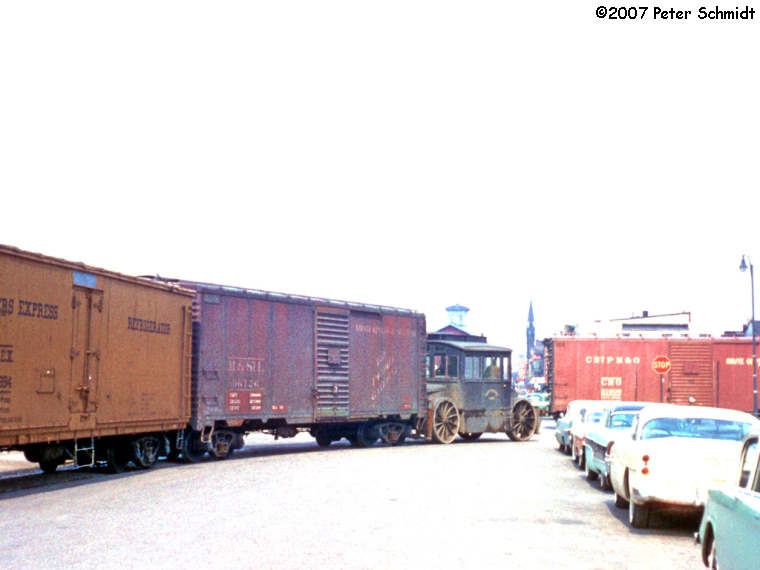
Another shot of the #446 heading from broadway into Thames.
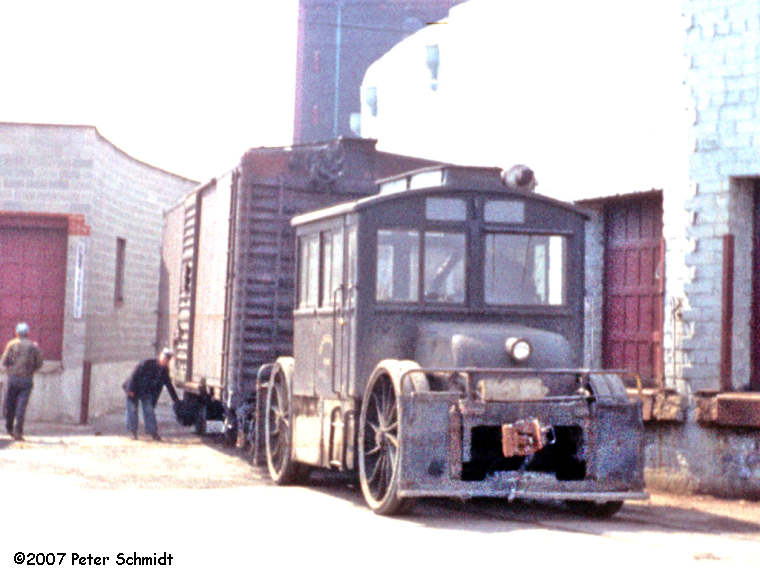
Switching out some cars on Wolfe Street south of Thames in Baltimore.

Another shot of the #446 heading down Thames.
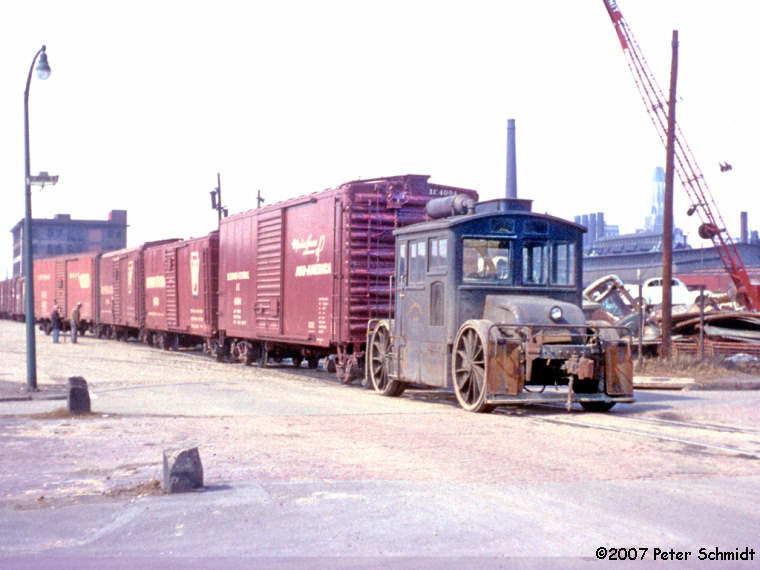
A member of class 3/8000 (possibly the 446) caught by Peter Schmidt on switching the Aliceanne Street Yard just west of Central, very near President Street Station (circt 1958).

Another photo just a few minutes later...

A somewhat grainy side view of unit #1 from the February 26, 1913 issue of "The Horseless Age" Here is the text from the article that accompanied the photo:
This Motor Truck Supplants Locomotive.
One of the most interesting applications of the motor truck of special design may be seen upon paying a visit to the Pennsylvania Railroad Co.'s freight yards in Jersey City. For many years the company has been compelled to employ several teams of horses in switching freight cars through certain streets and around curves where a locomotive would be too large or too heavy to take the curves or to pass through the heavy traffic which often exists in these streets which are used for transferring consignments to such concerns as Colgate & Co. and American Sugar Refining Co.
More than a year ago the railroad company made several tests with ordinary motor trucks of the heaviest type obtainable, but these were found to be too light to do the work. It was then that T. V. Buckwalter, chief electrical engineer for the Pennsylvania Railroad Co. at Altoona, Pa., and also a member of the Society of Automotive Engineers, conceived the idea of a special motor truck to do the work. The result is the massive mechanism shown in the accompanying illustration, which is reproduced by courtesy of Collier's Weekly.
This truck, which looks more like a special locomotive, which it really is, than an ordinary electric tractor, is limited to a speed of eight miles per hour. It is 22 feet in length and has a wheel base of only 12 feet. The tread is 6 feet inside the wheels and these being 12 inches in width, make the total width 8 feed. The machine weighs complete 28,850 pounds.
The motive power is supplied by two General Electric, 85 volt, series wound motors, one driving the front and the other the rear wheels through countershafts carrying differentials. In the outer end of each countershaft is a universal joint carrying a spur gear which drives a larger gear bolted directly to the inside of the wheel. The small gear is really a universal pinion, since the centre line of the joint passes through the centre of the gear face. The brakes are mounted inside the large gears. The motors are located under the hoods, one in front and one in the rear, and have a 40 to 1 reduction to the driving wheels. All wheels are provided with steering pivots and are operated from the driver's cab by means of a vertical hand wheel like that used in the pilot house of a boat. In place of heavy semi-elliptic leaf springs pneumatic cylinders are employed. These are said to require a pressure of 10,000 pounds in order to force the pistons to the bottom of the cylinders.
One of the most interesting features of the tractor is its control and braking system. It is made to run equally well in either direction and the control set is duplicated on either side of the driver's cab, so that in whichever direction the machine is traveling the control levers are on the right side. The speed leers operate in quadrants and control three forward and three reverse duplicate speeds on the opposite sides of the quadrants which are provided with a bridge or stop in the centre. In order to reverse, however, it is necessary to remove the control lever handle from its socket on one side of the centre stop and insert it in the socket on the opposite side. This construction prevents unintentional reversing. To stop the truck the current is turned off and air brakes applied in the same manner as in a locomotive. To provide for the failure of the air pressure an additional hand brake is installed. The machine can be brought to a stop from full speed within a yard.
In a recent tug o' war with a locomotive the tractor proved an easy winner.
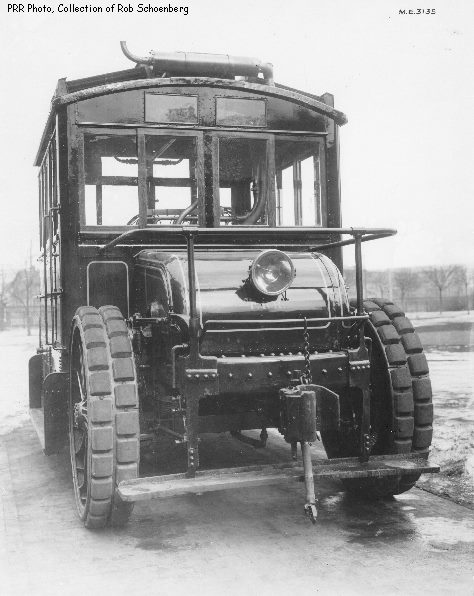
Builders photo of the end of unit #2 in Jersey City.
Pennsylvania Railroad Photo, Collection of Rob Schoenberg
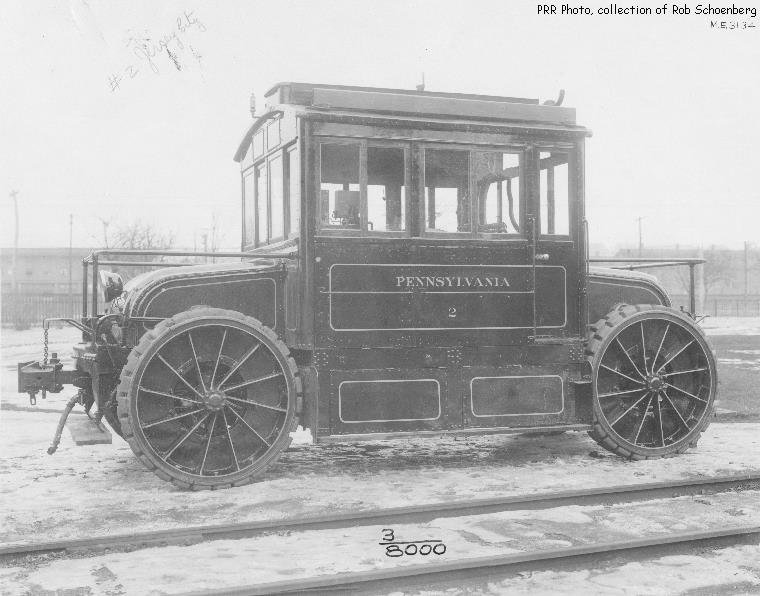
Builders photo of the side of unit #2 in Jersey City.
Pennsylvania Railroad Photo, Collection of Rob Schoenberg
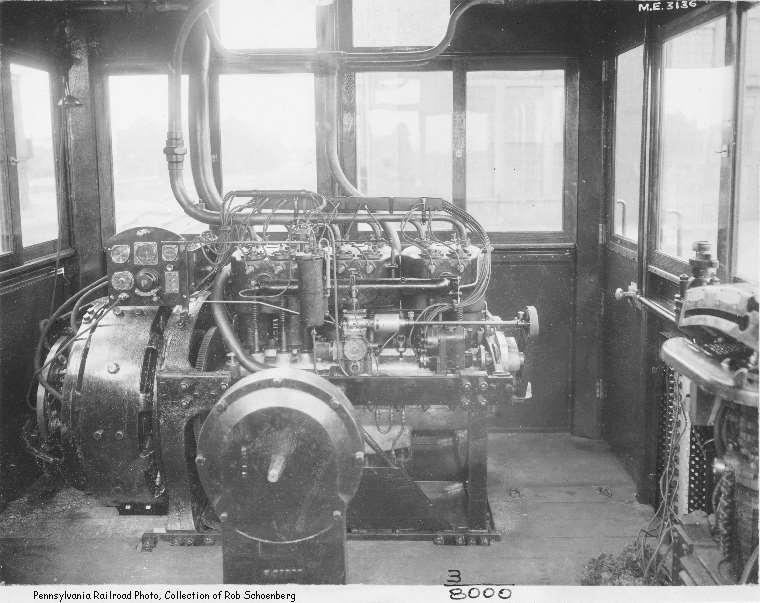
Builders photo of the interior of unit #2 in Jersey City.
Pennsylvania Railroad Photo, Collection of Rob Schoenberg
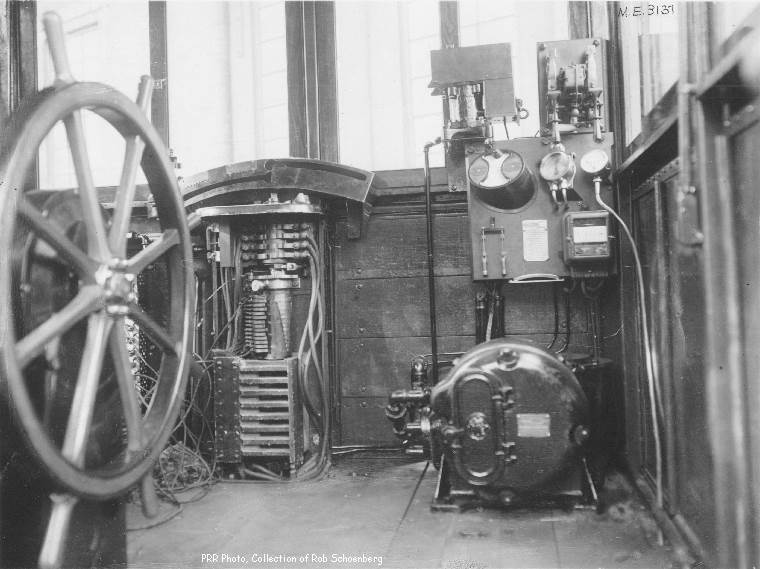
Another photo of the interior of unit #2.
Pennsylvania Railroad Photo, Collection of Rob Schoenberg
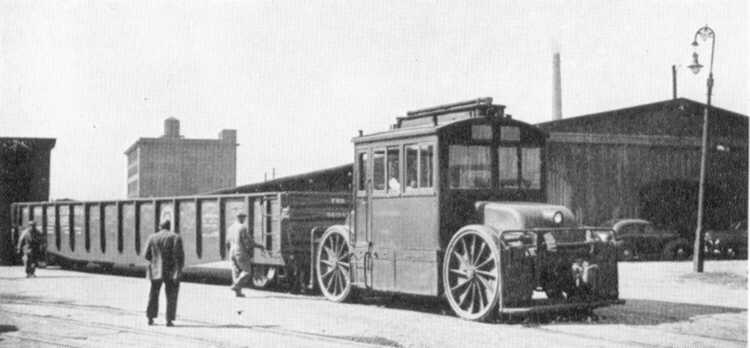
An anonymous switcher pulling a gondola at the Aliceanna Street yard in Baltimore. Date unknown.
Photographer unknown, collection of John H. Wright.
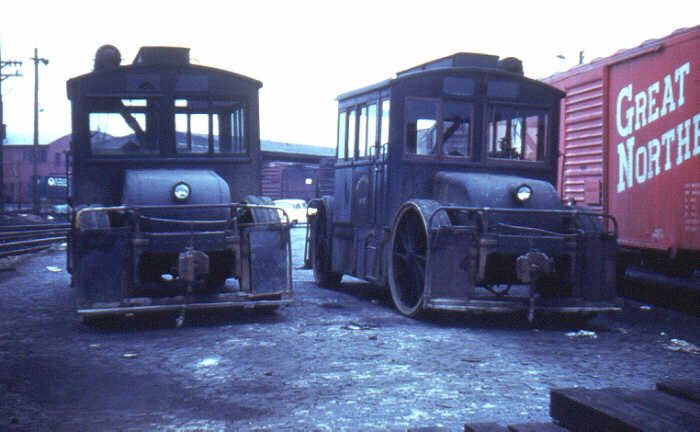
Two of the PRR's rubber tired switchers at the President Street Yard in Baltimore, on an unknown date.
Photographer unknown, collection of John H. Wright.
Ken Briers wrote in with the following: "I actually worked on the modern tractors a few times. The crew consisted of two Trainmen and a Conductor. I would imagine that one thing that kept this service going so long was the ability to avoid the cost of an Engineer. One of the Trainmen drove the tractor, and to do this, he had to be qualified as a "Chauffeur". The tractors had drawbars that would slide back and forth to compensate for the difference in "tracking" of the tractor from the rail-bound cars. In the modern tractors the chauffeur could actually move the drawbar from side to side remotely to align its coupler with that of the car to be coupled to. The olders models may also have had this feature, but I was never around them. The most dangerous thing about working on the street was remembering to look for traffic when you stepped out from between the cars after coupling hoses. "

Unit #3, a modern type of street tractor in Baltimore on Aliceanne at Bond.
Peter Schmidt photo, December 1968.

Another view of #3 from Peter Schmidt at the corner turning from Aliceanna Street onto Bond Street in Baltimore.

A third view of #3 from Peter Schmidt just down Bond Street from the previous photo.

Unit # 89240, Jersey City, NJ, exact location and date unknown.
It has New Jersey license plate XRF-590.
Note the PRR truck in the background. It appears to be one with
a removable "container" body.
Photograph by and collection of Ed Ruland

Here's another take on the Street Tractor concept. It's a Euclid tractor adapted to haul railcars. It has dealer license plates (1948) so perhaps it is something the PRR was testing? Here are four views seen at the corner of York Street and Hudson Street in Jersey City circa 1948.
Photographer unknown, collection of Rob Schoenberg

Here's a side view of the Euclid tractor.

Here's a rear 3/4 view coupled up to PRR 14380.
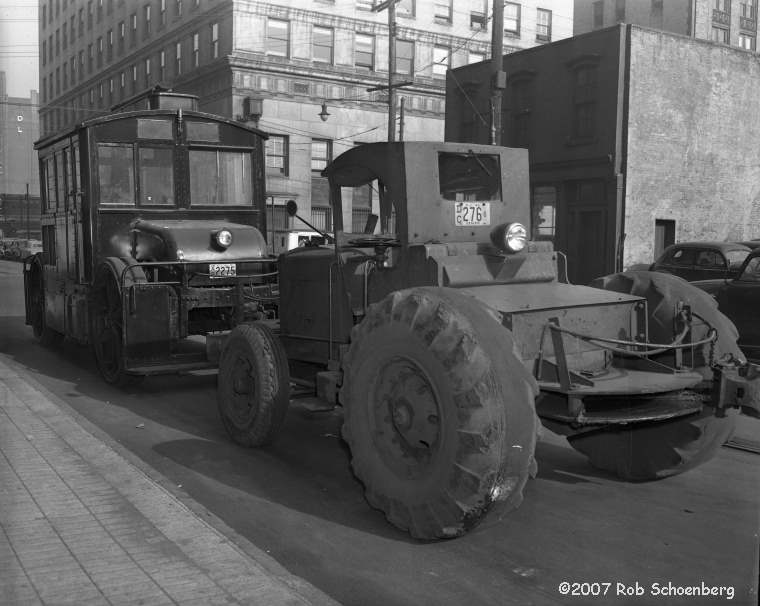
Here's a rear 3/4 view from the other side coupled up to PRR 14380.
| Unit # | page # | Book Title | Book author |
| #446 - spoked wheels | 92 | Pennsylvania Railroad 40's and 50's | Ball, Don |
| #444 - spoked wheels | 218 | Diesel Power Review | Carleton, Paul |
| #14380 | 218 | ||
| #1 - spoked wheels | 461 | Pennsy Power 3 | Staufer, Alvin |
| #14380 - spoked wheels | 461 | ||
| #89294 - modern unit | 461 | ||
| #89240 - modern unit | 461 | ||
| #446 - spoked wheels | 100 | PRR Color Pictorial Vol 1 | Sweeland, David |
| #445 - spoked wheels | 124 | PRR Color Pictorial Vol 2 | Sweetland, David |
| #14380 - pneumatic tires | 124 | ||
| #444 - spoked wheels | 38 | Trackside on the PRR North of Washington D.C. | Murray, Michael S. OSFS & Yanosey, Robert J . |
| 446 - spoked wheels | 126 | PRR Color Cuide to Frt & Pass Eq Vol3 | Fischer, Ian S. |
| 445 - spoked wheels | 44 | Pennsylvania Standard Railroad of the World | Plant, Jermey F. & Yanosey, Robert J. |
| ? - pneumatic tires | 44 | ||
| 445 - pneumatic tires, 9/2/64 | 14 | Pennsy Diesel Years Vol 3 | Yanosey, Robert J. |
| 14380 - pneumatic tires, 9/2/64 | 15 | ||
| 14380 - pneumatic tires, 9/2/64 | 15 | ||
| 445 - pneumatic tires, 9/2/64 | 16 | ||
| 445 - pneumatic tires, 9/2/64 | 16 | ||
| 89294? - modern Grove unit, 11/67 | 17 | ||
| 3 - modern unit, 4/77 | 17 | ||
| ? - spoked wheels | 17 | Trackside Maryland (From Railyard to Main Line) | Gallagher, James P. and Kelly, Jacques |
| ? - spoked wheels | 18 |
| Unit # | Date | Location | Negative # |
| 14380 | 1956 | ? | 23939 (b/w) |
| 14380 | 1956 | ? | 25940 (b/w) |
| Unit # | Date | Description | Negative # |
| 1 | 1912-1913 | side view | 1896-A |
| 1 | 1912-1913 | - | 1899-A |
| 1 | 1912-1913 | end view | 1900-A |
| 1 | 1912-1913 | side view | 1902-A |
| 1 | 1912-1913 | side view | 1903-A |
| 1 | 1912-1913 | end view | 1906-A |
| 14380 | 5/31/24 | side view | 6573 |
| 14380 | 5/31/24 | angular view | 6574 |
| 14380 | 5/31/24 | interior of cab | 6575 |
| Unit # | Date | Location | Negative # |
| 443 | 1/27/54 | Baltimore, MD | PR01362 (b/w) |
| 444 | 1946 | Baltimore, MD | PR01376 (b/w) |
| 445 | 4/8/50 | Baltimore, MD | PR00026 (b/w) |
| 446 | 11/62 | Baltimore, MD | PR50049 (color) |
| 14379 | 4/22/49 | Jersey City, NJ | PR00722 (b/w) |
| 14380 | 4/22/49 | Jersey City, NJ | PR00723 (b/w) |
I'd also like to thank Ed Ruland for sharing his photos of these switchers with me for this page!
Thanks to Joe Blatterman for providing location information for several of the Baltimore photos and Greg Brown for providing the Trackside Maryland info.
Also, thanks to Paul and Daphne Carleton of D. Carleton Railbooks for letting me use the two photos and captions from their book, A Pennsy Diesel Power Review!
Finally, thanks for everyone else who e-mailed comments or corrections for this page!